Loading…
War and conflict · book
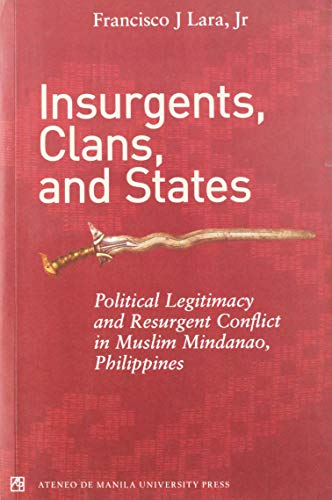
Insurgents, Clans, and States
Political Legitimacy and Resurgent Conflict in Muslim Mindanao, Philippines
- Publisher
- Ateneo de Manila University Press
- Year
- 2014
- Language
- English
- Pages
- 340
- ISBN
- 9789715506724
- Availability
- In print
Still in print: the link goes to a shop that sells it.
About the book
Why the conflict keeps returning: the clans, the rebel fronts and the state as rival sources of authority in Muslim Mindanao, and the shadow economy that sustains all three.
Francisco J. Lara Jr. asks why Moro rebels who gained political power could not keep their authority and legitimacy. Lara was Philippine country director of International Alert, the UK-based peacebuilding group. The 340-page study was published in the Ateneo de Manila University Press's Mindanao Studies series.
Lara shows how rebels who gave up their arms in exchange for formal office could not compete with powerful clans and local elites. Those clans offered basic security and took a growing share of internal revenue allotments under devolution. They also allowed a shadow economy to spread, which strengthened their power and let people earn a living with little state taxation.
The book draws 2 unsettling conclusions. Political legitimacy may come less from building a strong state than from weakening it, and less from building peace than from showing an ability to use violence. The publisher presents it as useful to anyone studying insurgency, local state-building and political settlements elsewhere.
From yuchengcomuseum.org, unipress.ateneo.edu, twsc.upd.edu.ph.
War and conflictPolitics and governanceEconomy and development
Cover from Amazon, shown to identify the book; its rights stay with the publisher.
More by Francisco J. Lara Jr.
2013Free to read
Out of the Shadowseds. Francisco J. Lara Jr. and Steven Schoofs
The shadow economies of Mindanao, from guns and drugs to the informal credit and trade that ordinary people live by, and how they feed and are fed by the conflict. Free to read.
On the same shelf
1985Out of print
The Contemporary Muslim Movement in the PhilippinesCesar Adib Majul
Majul’s short account of the Moro struggle of the 1970s and the rise of the Moro National Liberation Front, written for readers abroad.
1981In print
The Sulu Zone, 1768–1898James Francis Warren
The Sulu Sultanate at its height as a trading state: the China trade in sea produce, the slave raiding that fed it, and the peoples it drew in, from Spanish, British and Dutch archives. The book that made the Sulu Zone a field of study. Second edition 2007.
2000In print
Making MindanaoPatricio N. Abinales
How Cotabato and Davao were drawn into the Philippine state in the first half of the twentieth century, through the datus and settler elites who learned to work it, and what that made of Mindanao politics.
2010In print
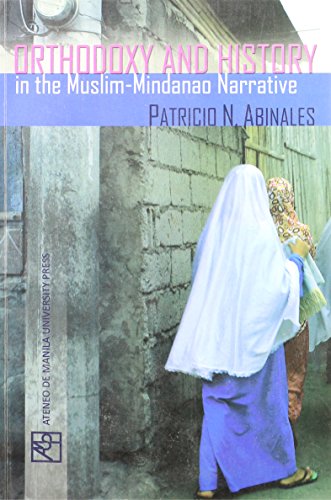
Orthodoxy and History in the Muslim-Mindanao NarrativePatricio N. Abinales
Essays questioning the received story of the Moro struggle, the unbroken resistance from Spain to the present, and asking what the record shows instead.
1995Self-published
Aristocrats of the Malay RaceNasser A. Marohomsalic
A history of the Moro peoples written from within, from the sultanates to the MNLF, by a Maranao lawyer; printed by the author and much cited in the region. Revised 2001.
1994Out of print
The Minoritization of the Indigenous Communities of Mindanao and the Sulu ArchipelagoB. R. (Rudy) Rodil
How the Moro and Lumad peoples became minorities in their own homeland: the land laws, the resettlement programmes and the migration from Luzon and the Visayas, with the figures.
More from Ateneo de Manila University Press
1991Out of print
Liberalism and the Quest for Islamic Identity in the PhilippinesKenneth E. Bauzon
How the liberal state and the Moro search for an Islamic political identity have failed to meet, by a Filipino political scientist.
2000In print
Making MindanaoPatricio N. Abinales
How Cotabato and Davao were drawn into the Philippine state in the first half of the twentieth century, through the datus and settler elites who learned to work it, and what that made of Mindanao politics.
2001In print
MagosahaH. Arlo Nimmo
Nimmo’s return to the Sama Dilaut three decades on: the full ethnography of a people who had by then mostly come ashore.
2004In print
The Great IslandMiguel A. Bernad
Essays on the exploration of Mindanao and the Christian missions there from the sixteenth century on, by a Jesuit historian who spent his later life in Cagayan de Oro.
2005In print
UkkilLigaya Fernando-Amilbangsa
The carved, woven and worked ornament of Sulu, ukkil, in a large illustrated study by the dancer and scholar who spent her life recording the archipelago’s arts.
2007In print
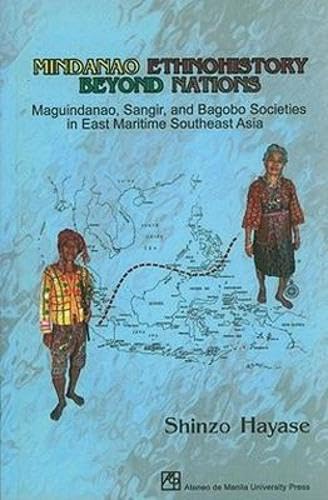
Mindanao Ethnohistory beyond NationsShinzo Hayase
Maguindanao, Sangir and Bagobo as peoples of one sea rather than of two countries, in a history that crosses the border with Indonesia the way they did.