Loading…
War and conflict · report
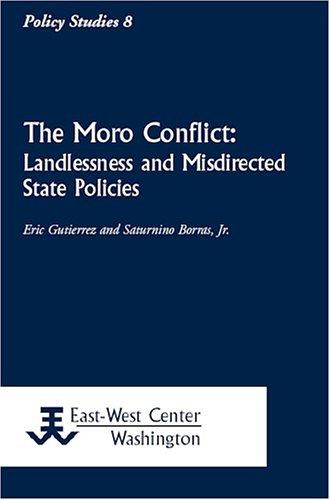
The Moro Conflict
Landlessness and Misdirected State Policies
Eric U. Gutierrez and Saturnino M. Borras Jr.
- Publisher
- East-West Center
- Year
- 2004
- Language
- English
- Pages
- 68
- ISBN
- 9781932728149
- Availability
- Free to read
Published free: the link opens the whole book.
About the book
The argument that land, not religion, is at the root of the Moro conflict: how colonial and Philippine land policy dispossessed the Moros and why the peace deals have not touched it. Free to read.
This East-West Center policy study offers a political and economic explanation of the conflict in the southern Philippines. It starts from 2 observations: Muslim areas have high poverty and social exclusion, and "entrepreneurs in violence" there enforce their own rules over property. The authors trace both to the very unequal ownership and control of land, rooted in colonial history.
The chapters cover settlement, migration and displacement, mass poverty, entrepreneurs in violence, and current land policies, followed by lessons. Tables give population trends from 1918 to 1970 and land distribution figures from the agrarian reform and environment departments.
The authors argue that redistributive land reform must be a central part of any lasting peace, joined to Moro and Lumad ancestral domain claims and to support services for poor farmers. They say neither successive governments nor the main Moro fronts have dealt with the land question.
The conflict in the southern Philippines is becoming increasingly complex, and untangling the knots for a greater understanding of the problem is no easy task. Yet underlying all these manifestations of a complex conflict is a straightforward political-economic explanation. This study argues that the continuing war, the persistence of poverty and landlessness, and the emergence of “entrepreneurs in violence” are mere symptoms of something that has not yet been sufficiently addressed by a succession of Philippine governments or even by mainstream Moro revolutionary organizations: the highly skewed distribution of ownership and control over land resources in the southern Philippines.
War and conflictEconomy and developmentPolitics and governance
Cover from Open Library, shown to identify the book; its rights stay with the publisher.
More by the same authors
2000Out of print
Rebels, Warlords, and Ulamaeds. Eric U. Gutierrez, Kristina Gaerlan and Mara Stankovitch
A reader on the war in the South at the end of the 1990s: the rebel fronts, the clan armies and the religious leaders, with primary documents and the authors’ reporting.
On the same shelf
1985Out of print
The Contemporary Muslim Movement in the PhilippinesCesar Adib Majul
Majul’s short account of the Moro struggle of the 1970s and the rise of the Moro National Liberation Front, written for readers abroad.
1981In print
The Sulu Zone, 1768–1898James Francis Warren
The Sulu Sultanate at its height as a trading state: the China trade in sea produce, the slave raiding that fed it, and the peoples it drew in, from Spanish, British and Dutch archives. The book that made the Sulu Zone a field of study. Second edition 2007.
2000In print
Making MindanaoPatricio N. Abinales
How Cotabato and Davao were drawn into the Philippine state in the first half of the twentieth century, through the datus and settler elites who learned to work it, and what that made of Mindanao politics.
2010In print
Orthodoxy and History in the Muslim-Mindanao NarrativePatricio N. Abinales
Essays questioning the received story of the Moro struggle, the unbroken resistance from Spain to the present, and asking what the record shows instead.
1995Self-published
Aristocrats of the Malay RaceNasser A. Marohomsalic
A history of the Moro peoples written from within, from the sultanates to the MNLF, by a Maranao lawyer; printed by the author and much cited in the region. Revised 2001.
1994Out of print
The Minoritization of the Indigenous Communities of Mindanao and the Sulu ArchipelagoB. R. (Rudy) Rodil
How the Moro and Lumad peoples became minorities in their own homeland: the land laws, the resettlement programmes and the migration from Luzon and the Visayas, with the figures.
More from East-West Center
2005Free to read
Forging Sustainable Peace in MindanaoSteven Rood
What civil society groups did and could do for peace in Mindanao, by the Asia Foundation’s long-serving Philippines representative. Free to read.